 |
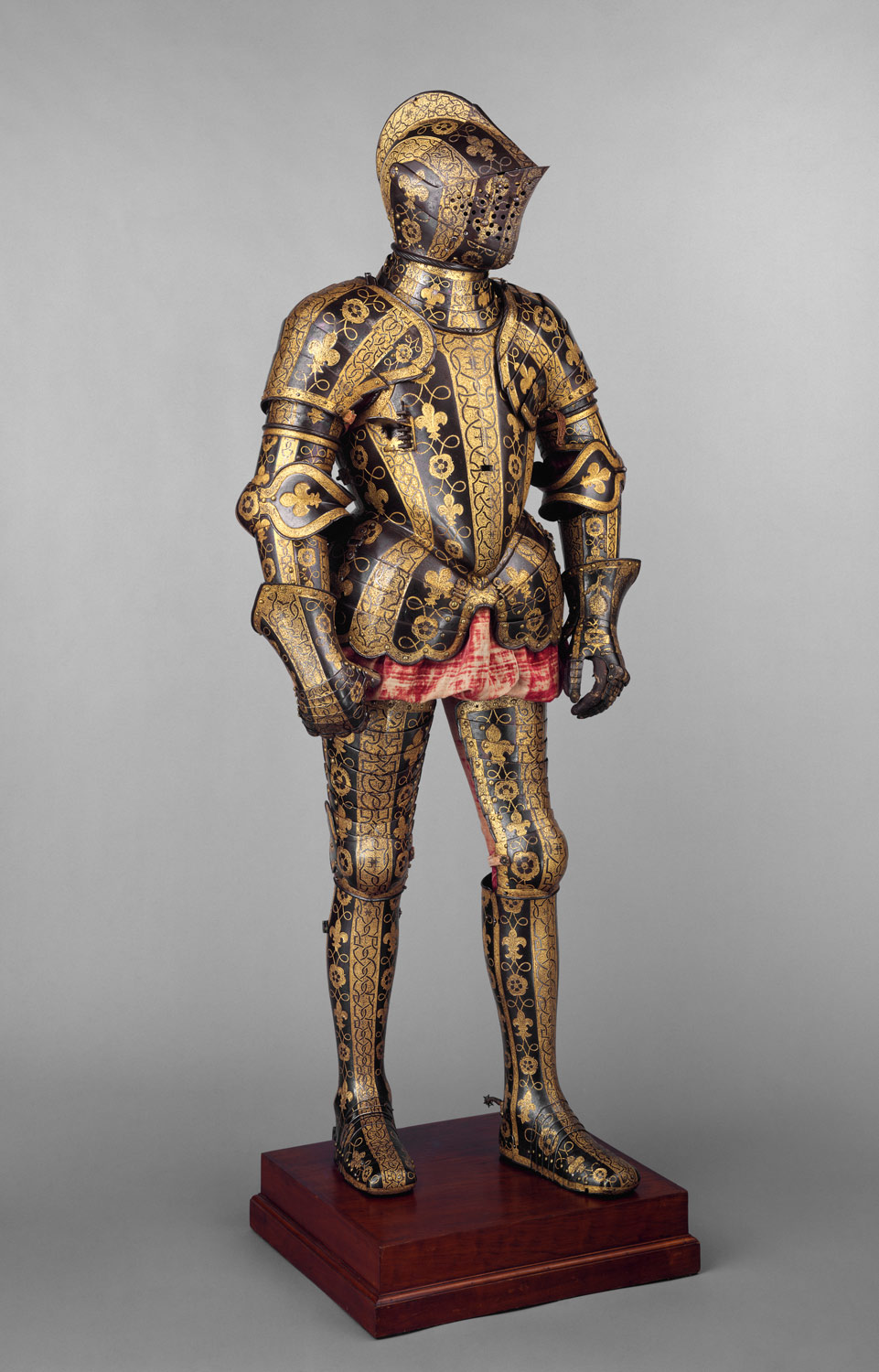
| Some dope armory |
George Clifford was appointed Queen's Champion in 1590 and was made a Knight of the Garter two years later. He is best remembered for his capture of the Spanish fort in San Juan, Puerto Rico, in 1598.
His armor was considered the finest surviving garniture of the Tudor period, and as the Queen's Champion, Clifford's armor would have been unrivaled in beauty. He chose to decorate the armor with the Tudor rose, the French fleur-de-lis, and the cipher of Elizabeth, two E's back to back. The symbols are patterned in stripes displayed upon the armor, with the roses and fleur-de-lis' together in a darker stripe and the ciphers of Elizabeth in a separate lighter stripe. While the armor is quite busy with all these patterns and symbols, it is in dull colors and isn't extreme. Next, the chosen symbols represent many things.
When Henry VII took the crown of England from Richard III in 1485, he brought the end of the retrospectively-dubbed 'Wars of the Roses' between the House of Lancaster and the House of York, which had used the badge of a red or gold rose and a white rose, respectively. On his marriage, Henry VII adopted the Tudor rose badge conjoining the two roses, representing the union of their houses. While being the English plant emblem, it is also a symbol of peace.
The French fleur-de-lis were later used by English kings on their coats of arms to emphasize their claims to the throne of France, and represented pride.
The cipher of Elizabeth simply shows Clifford's loyalty to the Queen, and represents his idea of the good nature of his Queen.
 |
| Here is my bad sketch of this dope armory |
The Cumberland armor, the best preserved, most extensive armor garniture from the Royal Workshops at Greenwich, also represents the technical and decorative peak of the Greenwich school. Just the fact that it has been preserved throughout all these years speaks for the durability and quality of the armor, and in turn the quality of the ones who made it.
