Sunday, December 18, 2016

Watched by Lady Macbeth...


Watched by Lady Macbeth...
Reign is a highly fictionalized series that follows the early exploits of Mary, Queen of Scots. Mary is an independent and powerful woman who has to contend with changing politics and power plays. But other than Mary, characters like Catherine de' Medici display other characteristics that surely relate to Lady Macbeth's ambition for power and flawless murder plotting.


Dexter centers on Dexter Morgan, a forensic technician specializing in blood spatter pattern analysis for the fictional Miami Metro Police Department, who leads a secret parallel life as a vigilante serial killer, hunting down murderers who have slipped through the cracks of the justice system. He has flawlessly slipped through those same cracks himself-- Lady Macbeth had to have gotten her flawless murder plans from somewhere, right? They both also seem to lack all humanity...

She's the Man is a film that centers on teenager Viola Hastings who enters her brother's school in his place, pretending to be male, in order to play with the boys' soccer team after her team gets cut. Viola can certainly vouch for the fact that Lady Macbeth isn't the only woman saying "unsex me now"! 


Maleficent had an idyllic life in a forest kingdom as a young woman with a pure heart. Maleficent rises up to become its fiercest protector, and a terrible betrayal hardens her heart and twists her into a creature bent on revenge. Not all villains are purely terrible, and I'm sure Lady Macbeth can sympathize with Maleficent and her corruption. 


Sunday, November 13, 2016

Blast to the Past

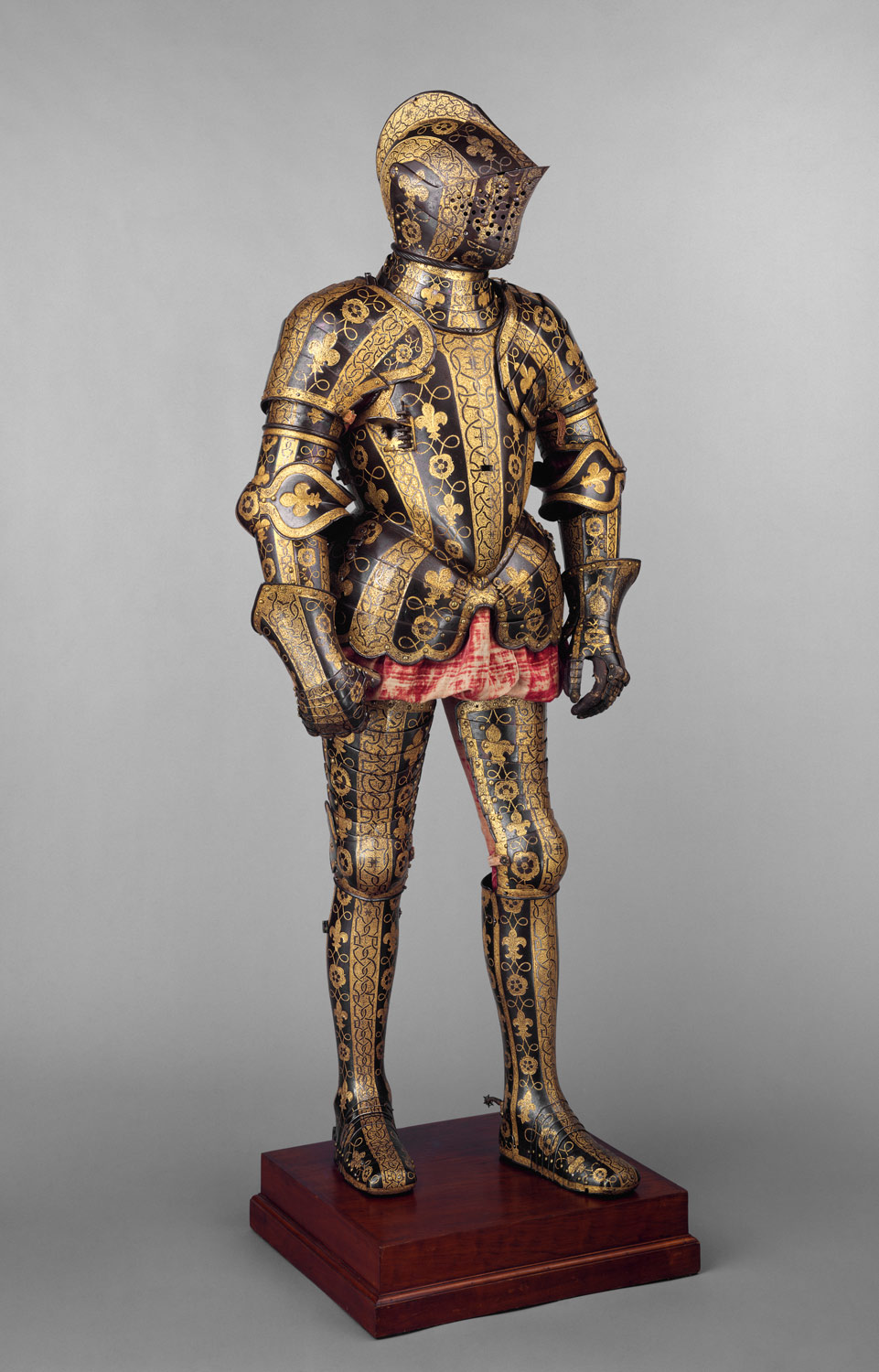
Some dope armory
This piece of art is the Armor Garniture of George Clifford, the Third Earl of Cumberland. It was made under the direction of Jacob Halder, a British master armorer, at the royal workshops at Greenwich. It was documented in England between 1558 and 1608. It is made out of steel, gold, leather, and textile, and is 69 1/2 inches tall weighing 60 pounds.

George Clifford was appointed Queen's Champion in 1590 and was made a Knight of the Garter two years later. He is best remembered for his capture of the Spanish fort in San Juan, Puerto Rico, in 1598.

His armor was considered the finest surviving garniture of the Tudor period, and as the Queen's Champion, Clifford's armor would have been unrivaled in beauty. He chose to decorate the armor with the Tudor rose, the French fleur-de-lis, and the cipher of Elizabeth, two E's back to back. The symbols are patterned in stripes displayed upon the armor, with the roses and fleur-de-lis' together in a darker stripe and the ciphers of Elizabeth in a separate lighter stripe. While the armor is quite busy with all these patterns and symbols, it is in dull colors and isn't extreme. Next, the chosen symbols represent many things.

When Henry VII took the crown of England from Richard III in 1485, he brought the end of the retrospectively-dubbed 'Wars of the Roses' between the House of Lancaster and the House of York, which had used the badge of a red or gold rose and a white rose, respectively. On his marriage, Henry VII adopted the Tudor rose badge conjoining the two roses, representing the union of their houses. While being the English plant emblem, it is also a symbol of peace.
The French fleur-de-lis were later used by English kings on their coats of arms to emphasize their claims to the throne of France, and represented pride.
The cipher of Elizabeth simply shows Clifford's loyalty to the Queen, and represents his idea of the good nature of his Queen.

Here is my bad sketch of this dope armory
This armory was decorated with symbols representing peace, pride, loyalty--chivalric characteristics. But just as easily as it could be used for battle, it could serve as decoration. The armor has such intricate designs with symbols that were desired by Clifford, symbols that represent qualities of a good and chivalric man. It seems silly to put so much time and effort into something that would only see such horrific scenes of battle and blood, but now we are thankful that all that time and effort was put in because we can experience a blast to the past and put some real aspects to the stories we have been told in our World History classes.

The Cumberland armor, the best preserved, most extensive armor garniture from the Royal Workshops at Greenwich, also represents the technical and decorative peak of the Greenwich school. Just the fact that it has been preserved throughout all these years speaks for the durability and quality of the armor, and in turn the quality of the ones who made it.


Thursday, October 27, 2016

Mr. Bratwurst

3. Identify and interpret the architectural images Jane uses to denote Mr. Brocklehurst in this chapter. What is the impact of these images on the development of his character?

"A long stride measured the schoolroom, and presently beside Miss Temple, who herself had risen, stood the same black column which had frowned on me so ominously from the hearthrug of Gateshead. I now glanced sideways at this piece of architecture. Yes, I was right: it was Mr. Brocklehurst, buttoned up in a surtout, and looking longer, narrower, and more rigid than ever."

I think its a very interesting and unique method of description to use architectural imagery to describe someone, and I think that also makes it a very good method of description.

As Mr. Brocklehurst (which sounds like Mr. Bratwurst) comes into the scene, Jane quite obviously has a very negative view towards him from the beginning. She outrightly states that she isn't looking forward to his arrival, and he is presented in a very negative light. This sets the stone for Mr. Bratwurst to have negative connoted descriptions, which consist of architectural comparisons. Jane first plainly says, "I now glanced sideways at this piece of architecture". Instead of metaphorically comparing him to architecture, she blatantly says so as if it was a defining quality of him. She then continues saying, "...looking longer, narrower, and more rigid than ever." These are characteristics that could easily be given to a skyscraper much less a human, and qualities that have more of a negative connotation, especially when describing a person. Additionally, she referred to him as a "black column" and a "long stride" which "measured the schoolroom". By referring to him as a black column he puts architectural characteristics on him in accordance with the color black which is generally a negative color, and by referring to him as a long stride that measured the schoolroom, she put non-human qualities onto him, supporting her purpose.

This creates a very dehumanized description of Mr. Bratwurst. I have never read Jane Eyre, and for all I know his character could be completely different, but from this excerpt I get the idea that Mr. Bratwurst is a very closed-minded and strict character, simply because he is described with dehumanizing imagery like a building. His character is developed in a way that suggests he isn't very human at all, and in a way he doesn't have basic human qualities like emotion and sympathy. The way he acts in the end of the excerpt toward the curly-haired girl kind of supports that idea.

The usage of this imagery really caught my attention because it isn't always that you hear someone described architecturally. I think this is what makes it such a good method of description, because it's so different.


Sunday, October 16, 2016

Little babe-magnet

When I looked at this assignment and saw that we had to find the seven deadly sins in advertising, I immediately thought of car advertisements. Cars can be advertised demonstrating ANY of the seven deadly sins. This specific ad is hilariously interesting to me for many reasons.

This is an ad made in 1996 by Daihatsu Motor Co. in Japan for the Daihatsu Hijet MPV. Most of the ad is taken up by the words, "Picks up five times more women than a Lamborghini", and then pictures a Daihatsu Hijet MPV with a man sitting in the front seat and five other women in the car. 

It is most likely intended for an audience of men. Specifically men that don't really have a way with women, which can be inferred by the message and the image of the man in the car. He is wearing large glasses and a turtle-neck, which is not a very attractive combination, if I do say so myself. The intended male audience is probably that of the middle class, because it compares the cheaper car being presented to a much more expensive Lamborghini, inferring the audience cannot afford such an expensive car. The intended audience is also probably very small-minded and single men, who are fooled by the use of women as a persuasive method.

The ad uses black and white coloring and formatting to create contrast between the words and the background and make the words the focus of the ad. The car is also in a white color, the same as the background, to not bring as much attention to it as the words. The words read, "Picks up five times more women than a Lamborghini". This ad clearly uses lust as a method of persuasion. The main focus of the ad is a sentence that suggests that this cheap and unattractive car is better compared to a Lamborghini just because it has more space to pick up specifically women. Lamborghini is a car company that was extremely successful at the time, and comparing their crap car to Lambo was a big mistake in my point of view. Especially since it is suggesting that the only reason it is better than a Lambo is because of the amount of women it can hold. You should also read the fine print at the bottom that you probably assume are factual details about the car itself. The little paragraph begins with, "Forget your Italian racers. This little babe-magnet is the Daihatsu Hijet MPV. Don't laugh... Two sun roofs for when things get hot." I find it hilarious because its basing it's entire advertising methods on the subjugation of women and the assumption that the intended audience won't realize how crap of a car it is after being told it can hold five women. No wonder this ad and this car had no success whatsoever. 

Sunday, October 2, 2016

Sonia Rosemarie Wrobel

Every single part of my name has always been, and always will be, mispronounced. Sonia Rosemarie Wrobel. I have always had mixed feelings about my name. I love how unique it is because nobody has the same name; I have only ever met 3 people with the name Sonia. But I also hate the fact that it is never pronounced right, and Sawn-ya Rosemary Wraw-ble does not sound very pretty in my opinion.

Sonia is a name that doesn't really have a single origin. I've been told its Brazilian, Polish, Italian, Slovakian, and many others. My parents told me that they liked the sound of my name. They liked how it flowed. My name also means 'wisdom', but my parents didn't even know that until I told them one day after researching the origin of my name. I have always had negative feelings towards it because of the common mispronunciations and lack of meaning. That is why I have never let it define me. I think my first name is a method of identification, but in order to define me it has to have meaning, which to me it doesn't. Although I have always been made fun of for having an herb as a middle name, Rosemarie has more meaning because it stems from both my grandmothers; my mother's mom's name is Rosa, and my father's mom's middle name is Marie. This pleases me because it reminds me that I will always have a part of them with me, even though its just in my name, which gives it meaning. Because of this, I was an advocate for hyphenated last names for children, because then their last name would represent both sides of their family. But then I realized once they got married to another hyphenated-last-named person, and they had more children, it would get pretty messy. Imagine "Sonia Wrobel-Greene-Villari-Dovinola"--yikes!

Anna Quindlen, in her essay "The Name is Mine", remarks,"there are two me's, the me who is the individual and the me who is a part of a family of four..." Quindlen's essay relates quite a lot to my mother. My mother, Maria Rita Villari, kept her last name instead of taking the Wrobel name, and I had asked the same question to my mother that Quindlen's son asked her. My mother assured me that her name was part of who she was, but she also didn't believe that she was obligated to change her name just because she got married. My mom answers to Mrs. Wrobel even though she doesn't technically identify as a Wrobel, and in doing that she represents her "me" that is part of a family. Yet, she stays true to her name's individuality, her other "me". The individuality of my mother's name especially identifies her as an Italian; Villari is such an Italian name that almost anyone can realize it immediately. She already moved across the world for my father, so she believed she shouldn't have to get rid of part of her Italian identity as well. I always completely understood why she kept it and had decided as a child that when I get married I will keep my name as well.

In addition to representing something as simple as a name, I think Quindlen's quote also represents the struggles of being an individual who is part of a larger whole in our current society. As an individual in our society, its difficult also being part of the larger whole because of the different judgements and perspectives put in place. People can be mean, especially today with so many controversial issues being brought up to the surface. I think I really became "two" when I entered the IB Program. That's when I really had to start thinking critically about situations and I began to formulate my own opinions on ideas. I have become "two" because I am an individual now with specific ideas and views, but I also feel the need to conform into the larger whole. Although I should be proud of who I am and what I believe, I don't reveal it all because of judgement and the large amount of my peers and friends who are very strong in their beliefs. I am a people-pleaser, I do everything that I do for the good of other people, and that forces me to be "two". What other people see, is not necessarily the truth.

Anna Quindlen's quote, while describing the complex of a name, also represents the complex of society and one's role in it. Therefore, the same way I believe my name doesn't define myself, I don't think a specific version of "me" can define myself either. What I reveal to other people does not make me who I am. I get to decide what defines myself.


Sunday, September 18, 2016

Hai from Tip Top Haircuts


Tip Top © Wing Young Huie
"Othering" is a term that means he process of perceiving or portraying someone or something as fundamentally different or alien. Author Margaret Atwood, along with photographer Wing Young Huie, portray this concept through their art. 

This picture was taken by Wing Young Huie in Minneapolis, Minnesota, in 2012. Huie is a photographer who is known for innovative photography projects which engage the community. He would speak to occupants in the neighborhood, and ask to take their picture. He would then display the photographs and quotes in the same neighborhood, in sizes from small enough to fit in a storefront window to large enough to drape the side of the empty Sears building. 

When first glancing at this picture, one would identify a white room messy with pictures on the walls and colorful objects on the counter, and a small Asian man in the background. He is in a barber shop, which could be inferred by the hair brushes and products, and general setting of the picture. By looking at this picture, the audience "others" this man. He is looked upon as small and insignificant, and is fundamentally different than the rest of the community that passes by his shop. 

Huie shows this man, named Hai, as the "others" by using layout and format, and contrast and color. He formats Hai in the very back of the room, making him seem small and insignificant, blending into the scene. The room is very contrasting itself, with a completely white background and very colorful objects inhabiting it, and Hai is even more blended in because of this. With this analysis, we can tell that Huie was trying to portray the fact that Hai is considered as an "other" because of his race. 

Contrastingly, Margaret Atwood, in The Handmaid's Tale, puts emphasis on the "others" in the Republic of Gilead. The "others" are represented by people like Moira, who stand out in the community because of their non-conforming actions and apparel. Opposite of our society, people that blend into the society of Gilead cannot be considered as different, because that means they conform to be the same as everyone else. Atwood creates this idea of conformity by describing the similar clothing everyone must wear, and the similar actions they all must take by using lots of dehumanizing personification and lots of detail. Therefore, opposite of the portrayal of "others" in The Handmaid's Tale, Hai is conveyed as so insignificant and alien to the point of seeming invisible. 

Hai Singing © Wing Young Huie
Huie makes an attempt to get to know Hai's past, and after several visits, lots of information about him is revealed. The audience figures out that Hai is a veteran of the Vietnam war and immigrated here from Vietnam because he hated communism. He loves to write music and the 40 songs he’s written in 20 years traverse loss and migration, witnessing burning bodies in India, sights in Alaska and Wyoming, the death of his mother and the memories of his homeland of Vietnam before the Communists took it over. He finds joy in helping people, and even though he doesn't get as many customers as he would like, he finds it much more pleasant than in Vietnam.
"What better way to understand American culture than to make people look nice? My clients come from all over the world: Mexico, Laos, China, Cambodia, Russia, Africa. You don’t have to be a politician to affect a community. You can just be a small business owner." - Hai

By discovering the context of this man's past, you can see that by "othering" him, all you are doing is harming yourself. He is looked at as different and alien to us and our race, but he is an incredibly interesting character and person and doesn't deserve to be looked at as alien. 

Overall, I really love Hai and I think he is the cutest human being on earth and I really want to meet him and get a haircut from him and listen to one, or all, of his songs because he is so adorable.